 Get the Friday Bulletin
 Member Hub Sign In
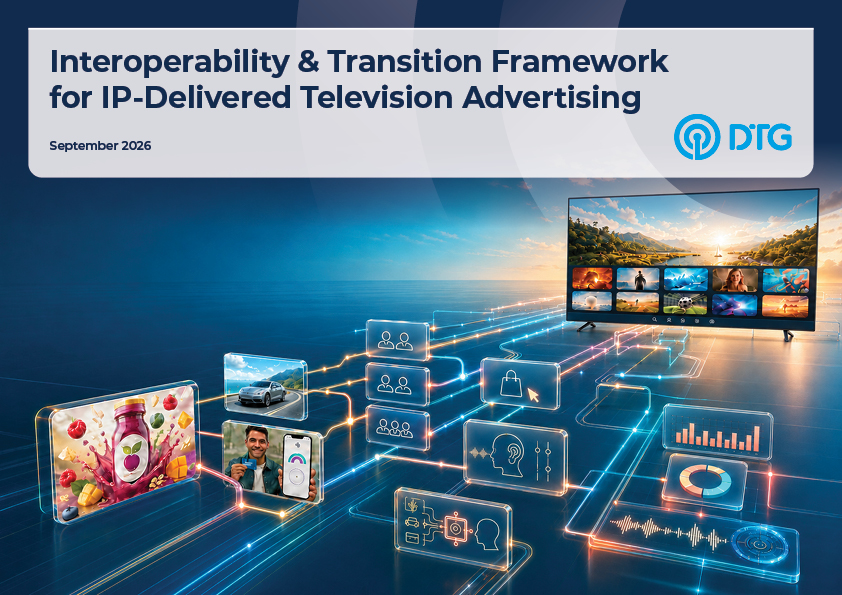
Interoperability & Transition Framework for IP-Delivered Television Advertising
A common reference model for the television advertising ecosystem
The DTG IP Advertising Framework is the outcome of a collaborative industry programme undertaken between November 2025 and July 2026. Over an eight-month period, more than 50 organisations from across the television advertising ecosystem contributed through Working Group meetings, workshops, technical discussions and industry consultation.
The Framework does not define new standards or prescribe a single implementation model. It provides a common reference model that helps explain the relationships between technologies, operational processes and commercial practices – complementing the work of existing standards organisations and industry initiatives.
Nov 2025 – Jul 2026
the advertising ecosystem
cross-cutting dimension
the industry
Download the full report
The complete 76-page Framework – strategic context, all six ecosystem layers, findings and appendices.
Scope
What the Framework is – and what it is not
The Framework should be distinguished from the standards, technical specifications and commercial initiatives that define or govern specific aspects of television advertising.
The Framework is…
- A common industry reference model
- A conceptual framework describing functional domains
- A guide to interoperability
- A common language for industry collaboration
- A foundation for implementation guidance
- A means of understanding relationships between technologies, standards and commercial processes
The Framework is not…
- A new standards body
- A technical specification
- A replacement for existing standards
- A proprietary technology architecture
- A mandatory certification programme
- A prescribed implementation model
The Framework
Five functional domains
The Framework is organised around five interconnected functional domains representing the principal operational capabilities of the IP television advertising ecosystem. They should not be read as a linear workflow – information, decisions and dependencies flow in multiple directions between them.
Creative, Clearance & Workflow Automation
Creation, approval and operational management of advertising assets.
Chapter 5Metadata, Signals & Interoperability
Consistent exchange of information between advertising systems.
Chapter 6Trading, Decisioning & Commercial Models
Inventory management, campaign execution and audience activation.
Chapter 7Delivery Infrastructure & Execution
Reliable advertisement delivery across multiple environments and devices.
Chapter 9Measurement & Attribution
Campaign reporting, audience measurement, verification and commercial optimisation.
Chapter 10Metadata acts as the connective layer across all five domains – increasingly operational infrastructure rather than descriptive information.
Identity, Consent & Privacy
No longer an isolated compliance consideration. Identity, consent and privacy influence audience activation, information exchange, advertising delivery and measurement across every functional domain – making trust and transparency fundamental components of modern advertising infrastructure.
Chapter 8Principal Findings
Five themes that recur across the advertising lifecycle
Interoperability has become the industry’s primary implementation challenge
Future progress depends less upon developing new technologies than upon enabling existing capabilities to operate together consistently across organisations, platforms and commercial environments. Many challenges arise not from a lack of standards, but from differences in implementation and operational practice.
Metadata has become operational infrastructure
Metadata no longer simply describes content or advertising assets. It enables creative production, audience activation, campaign decisioning, delivery, measurement and automation – making its consistent creation, exchange and interpretation fundamental to interoperability.
Commercial interoperability is increasingly important
Improving interoperability between direct sales, private marketplaces and automated trading has the potential to increase campaign effectiveness, improve inventory utilisation and strengthen advertiser confidence – while preserving the premium characteristics that distinguish television advertising.
Identity, consent and privacy influence every functional domain
These are no longer isolated compliance considerations. They increasingly influence audience activation, information exchange, advertising delivery and measurement, making trust and transparency fundamental components of modern advertising infrastructure.
Delivery and measurement form a continuous operational feedback loop
Reliable delivery enables trusted measurement, while measurement increasingly informs campaign optimisation, commercial decisioning and future planning. These capabilities should be considered as part of a continuous operational cycle rather than independent technical functions.
Strategic Recommendations
Six recommendations to support continued evolution
The Working Group recommends that future activity focuses on practical implementation and collaboration, building upon and complementing existing standards and industry initiatives wherever possible.
Adopt the Framework as a Common Reference Model
Promote the Framework as a shared reference model that complements existing standards by providing a common understanding of the IP television advertising ecosystem.
- Establish common terminology
- Improve understanding of functional dependencies
- Support industry collaboration and discussion
- Provide context for future implementation guidance
Prioritise Practical Implementation Guidance
Focus future work on practical implementation guidance that complements existing standards, technologies and industry initiatives.
- Metadata implementation
- Creative workflows
- Campaign management
- Delivery architectures
- Measurement practices
- Identity, consent and privacy implementation
- Interoperability between advertising platforms and delivery environments
Strengthen Collaboration Across the Industry
Continue collaboration across media owners, advertisers, agencies, platform operators, technology providers and relevant industry bodies. New standards or guidance should only be considered where existing approaches do not adequately address industry requirements.
- Map existing initiatives
- Identify dependencies
- Share implementation experience
- Engage standards organisations and industry bodies
- Understand where genuine gaps remain
Improve Information Exchange and Interoperability
Promote greater consistency in the way advertising information is described, exchanged and interpreted throughout the advertising lifecycle.
- Metadata quality
- Metadata availability
- Shared terminology
- Audience information
- Campaign signalling
- Measurement information
Support Commercial Growth Through Interoperability
Recognise interoperability as both a technical and a commercial opportunity, considered alongside technical interoperability throughout future industry activity.
- Increased utilisation of premium inventory
- Greater advertiser confidence
- More effective audience activation
- Scalable automation
- Greater operational scalability
- Reduced barriers to participation
- Improved accessibility for advertisers of different sizes, including SMEs
Establish a Continuing Industry Programme
Publication of this Framework should be viewed as the beginning of an ongoing programme of industry collaboration rather than its conclusion. Maintaining a common understanding of interoperability will require continued engagement, practical implementation and periodic review.
Downloads
Download the report by part or chapter
The Framework is published as a single integrated report. Each section is also available separately, along with the six individual chapters of Part 2 for readers focused on a specific ecosystem layer.
Full Report
The complete integrated Framework: strategic context, all six ecosystem layers, consolidated findings and appendices.
Download PDFExecutive Summary
- Foreword
- Executive Summary
- Understanding the Television Advertising Ecosystem
- Principal Findings
- Strategic Recommendations & Looking Ahead
Why television advertising is changing, what the Framework is, how today’s ecosystem models differ, and how the functional domains depend upon one another.
- 1 The Transition to IP Television Advertising · pp. 10–13
- 2 Defining the DTG IP Advertising Framework · pp. 14–19
- 3 Ecosystem Models & Operational Architectures · pp. 20–23
- 4 Interdependencies Across the Framework · pp. 24–26
The six domain chapters, each examining a layer of the ecosystem in depth – its current state, interoperability challenges, dependencies, commercial implications, recommendations and open questions. Download the Part in full, or take a single chapter.
Download Part Two in fullThe programme’s consolidated recommendations and forward work programme, together with the shared vocabulary that supports the Framework.
Download Part 3 in fullPart Three: Consolidated Findings & Recommendations
- Strategic Recommendations (11.1)
- Future Work Programme (11.2)
Appendices
- Appendix A: Glossary
- Appendix B: Acronyms, Abbreviations & Technical Terms
- Acknowledgements
Who the Framework is for
Different objectives, shared dependencies
The Framework supports organisations of different sizes and levels of technical maturity. One of its guiding principles is that interoperability should reduce complexity, not create additional barriers to participation.
| Stakeholder | Why the Framework matters |
|---|---|
| Media Owners | Maintain the premium value of trusted television advertising while maximising the value of inventory across both direct and programmatic trading environments. |
| Advertisers & Agencies | Improve campaign consistency, increase transparency, reduce operational complexity and lower barriers to accessing television advertising – enabling a broader range of advertisers, including SMEs, to participate. |
| Technology Providers | Improve interoperability between systems, reduce implementation complexity and support scalable innovation across multiple platforms and commercial models. |
| Platform Operators & OEMs | Enable consistent information exchange and advertising activation whilst supporting differentiated platform capabilities and commercial models. |
| Standards Organisations | Promote common terminology, implementation guidance and alignment between existing standards and initiatives. |
| The Wider Industry | Support greater interoperability, increase commercial opportunity, reduce unnecessary fragmentation and enable sustainable long-term innovation. |
Future Work Programme
Publication is the beginning, not the conclusion
Building on the recommendations set out in the report, the DTG IP Advertising Group intends to focus its initial activities on the following areas.
- Review and prioritise the recommendations that offer the greatest potential to improve interoperability, operational efficiency and commercial scalability.
- Continue engagement with stakeholders across the ecosystem to gather feedback and encourage wider adoption of the Framework.
- Map existing standards, specifications and industry initiatives against the Framework to identify alignment, overlap and implementation gaps.
- Prioritise a small number of implementation guidance topics where practical guidance may accelerate adoption.
- Establish focused Working Group activities to explore specific interoperability challenges identified during the programme.
- Explore requirements for a common measurement interoperability specification, and assess opportunities for collaborative pilots.
- Develop case studies illustrating successful implementation approaches across different television advertising environments.
- Periodically review and update the Framework to reflect emerging technologies and wider industry developments.
Get involved
The Framework continues to evolve. DTG members can join the IP Advertising Working Group directly; everyone else is welcome to register an interest in the programme.
Join the programme
Get involved
The DTG IP Advertising Working Group continues to meet as the Framework evolves. If your organisation is already a DTG member you can join the group directly.
The DTG team will be in touch by email.
Acknowledgements
Developed with the industry
The DTG would like to thank the individuals who provided leadership and oversight for the development of this report, and the organisations that participated in workshops, Working Group discussions and review activities.
Chair
- Devendra Mishra, Senior Manager, Advanced Advertising Technology, Virgin Media O2
Editorial and Technical Contributors
- Stuart Boorn, Head of Product – Media and Broadcast, Arqiva
- Alex Buchan, CTO, Digital TV Group
- Tom Dunning, CEO and Co-founder, Snicket Labs
- Justin Gupta, Head of Broadcast & Video Ads, Google Ad Manager EMEA, Google
- Ranjeet Kaur, Programme Director, Digital TV Group
Contributing Organisations
- Addressable TV Initiative (ATVI)
- Amagi
- Amazon
- Arqiva
- Ateme
- Barb Audiences Ltd
- BCi Digital
- Bitmovin
- Broadpeak
- BT Group plc
- Castlabs
- Channel 4
- Clearcast
- Digital Television Group (DTG)
- DTG Testing
- Enensys
- European Programmatic TV Initiative (EPTVI)
- Everyone TV
- Gracenote
- Hisense
- IAB UK
- Imagine Communications
- ITV
- Konodrac
- LG Electronics
- Liberty Global
- NBCUniversal
- Nice People at Work (NPAW)
- NOW
- Red Bee Media
- Roku
- Samsung Electronics
- Simplestream
- Sky Media
- Snicket Labs
- Strategy & Technology Ltd
- Synamedia
- Tellygence
- The Weather Company
- ThinkAnalytics
- TP Vision
- University of Surrey (PAI)
- VIDAA
- Virgin Media O2
- WPP Media
- Yospace
- Yotta Media Labs
- YouView
- Zixi
Participation in the review process does not imply endorsement of every finding or recommendation contained within this report.